
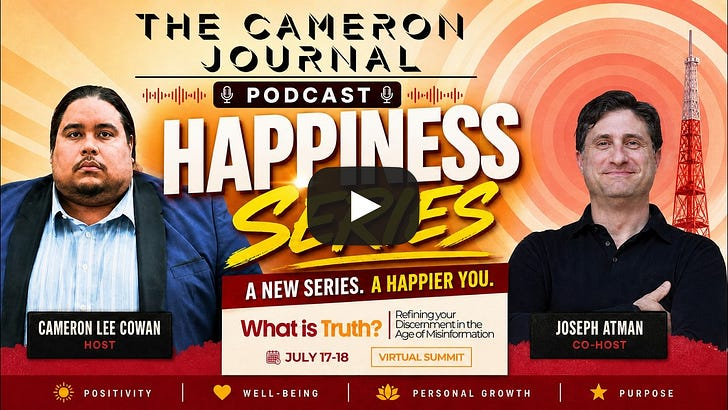
There is a particular kind of television, or podcast, or whatever we are now supposed to call long-form video conversation, that works precisely because it refuses to be tidy. The finale of the Happiness Series, the closing chapter in an ongoing dialogue between Cameron Lee Cowan and Joe Atman, is that kind of production. It does not arrive polished into a bow. It arrives raw, occasionally uncomfortable, and unmistakably honest, which is exactly why it matters and exactly why it is worth watching before it disappears into the archive of episodes people wish they had caught in real time. Read the full Substack here!

For several installments now, Cowan and Atman have been circling one of the oldest and most stubborn questions available to anyone willing to sit with it: what is happiness, actually, once you strip away the greeting card language and the self-help marketing that has flattened the word into something closer to a mood than a philosophy. The series has treated happiness less as a destination and more as an argument, one that plays out differently depending on who is doing the arguing. That tension is precisely what gives the finale its charge. Atman arrives with his familiar conviction that happiness is best understood as a state of being rather than an achievement to chase or a feeling to manufacture on demand. Cowan, for his part, brings something rawer to the table this time around, a willingness to let the conversation get personal in a way that earlier episodes only gestured toward.
What results is an episode that is emotional in the literal sense, not the marketing sense. Viewers get an unguarded look at Cowan working through real frustration and real vulnerability live, in the middle of a conversation about self-care, boundaries, and what it actually costs a person to keep showing up publicly week after week while still trying to protect their own peace. It is the kind of moment that most media training would sand down or cut entirely. Here it stays in, and the decision to leave it in is itself a statement about what this series has always been trying to do, which is model something closer to honest human processing than performance. Atman, characteristically, does not let the moment slide into indulgence. He pushes back, questions, and at points outright challenges Cowan, and the resulting friction between the two of them is less a disagreement for its own sake than it is two people testing an idea against lived experience in real time. That sparring is the engine of the episode, and it is also the reason the finale works as a culmination rather than simply another installment. The series set out to interrogate happiness rather than package it, and the finale delivers on that premise by refusing to let either host retreat into abstraction when the conversation turns uncomfortable.
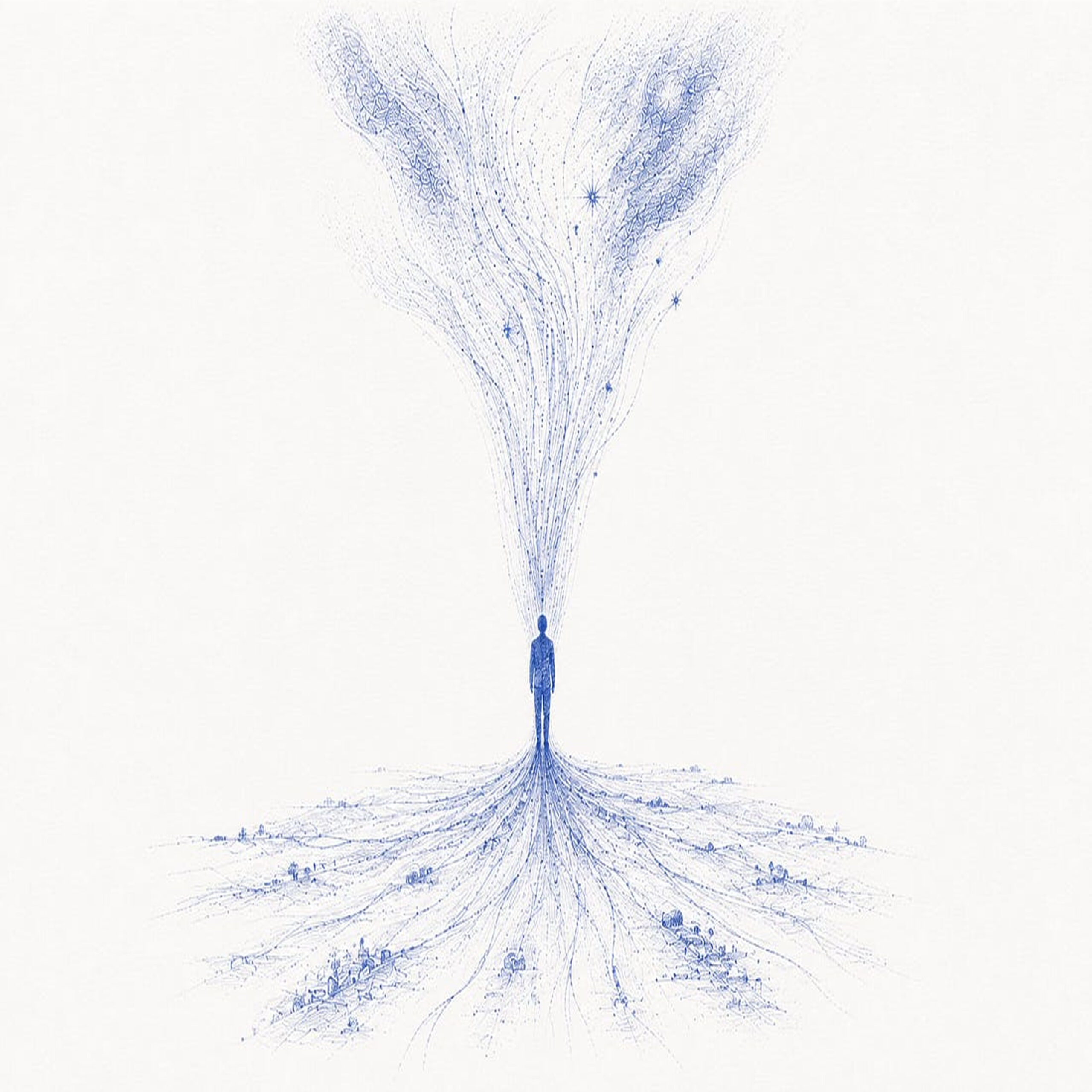
The philosophical backbone underneath all of this, the idea that happiness is a state of being rather than a pursuit, deserves more unpacking than a single episode description can offer, and it connects directly to a broader line of thinking Atman has been developing in his own writing. In a recent essay, Atman lays out an argument that reframes the entire question of human agency, and by extension the entire question of what an emotion like happiness even is. His premise is that most of what we experience, whether an emotion, a thought, or an action, is not something we originate so much as something that moves through us. We tend to think of ourselves as the authors of our own inner lives, but Atman’s argument suggests something closer to the opposite: that individuals function as conduits, drawing phenomena into existence rather than standing apart from it as neutral observers. Under that framing, an emotion is not manufactured from scratch by the person feeling it. It is channeled, shaped by inherited ideas, older cultural patterns, and ways of being that were formed long before the moment we happen to be living in and that get pressed onto us regardless of whether they still fit.
That idea has real consequences for how a person might think about happiness specifically. If happiness is not a prize to be won through effort or an emotion to be summoned through the right combination of habits and mindset tricks, but rather a state that arises when a person is aligned with something larger moving through them, then the entire self-improvement industry built around chasing happiness starts to look like it is solving the wrong problem. This is the tension the finale sits inside of, and it is why the emotional volatility of the episode is not incidental to the argument but central to it. Cowan’s visible struggle in real time becomes a kind of live demonstration of the very idea Atman is describing: an individual caught inside forces larger than deliberate personal effort, working through something rather than simply deciding to feel differently.
The finale also functions as a hinge point, closing one long-running conversation while opening the door to a considerably larger one. Cowan and Atman are using the end of the Happiness Series to announce the What is Truth Summit, a two-day gathering scheduled for July 17 and 18 that expands the underlying inquiry well beyond happiness alone and into the broader question of what truth is and how a person comes to recognize it. Given the philosophical throughline connecting the series to Atman’s writing on agency and inherited ways of being, the summit reads as a natural next step rather than a pivot. If so much of what we take to be personally generated, our emotions, our judgments, our sense of what is true, actually arrives already shaped by forces and inheritances outside our conscious control, then the question of truth becomes just as urgent and just as personal as the question of happiness ever was. Full details on the summit, including its schedule and the discussions planned across both days, are available through the event’s official site, and anyone who found the tension in the Happiness Series finale compelling will likely find the summit doing similar work at a larger scale.
Taken together, the finale and the summit announcement mark a deliberate escalation rather than a conclusion. The Happiness Series spent its run treating a familiar word with the seriousness it rarely gets, refusing to let happiness collapse into cliché, and its last episode earns that effort by staying messy, human, and unresolved exactly where a lesser production would have tried to wrap things up neatly. Cowan and Atman are not interested in neat. They are interested in what actually happens when two people who disagree keep talking anyway, and in watching an idea get tested against a real emotional moment instead of staying safely theoretical. That is worth watching on its own terms, and it is also the clearest possible setup for a summit built to ask an even harder question than the one this series just finished answering.
Read the full Substack here! Click here for the Summit Information!